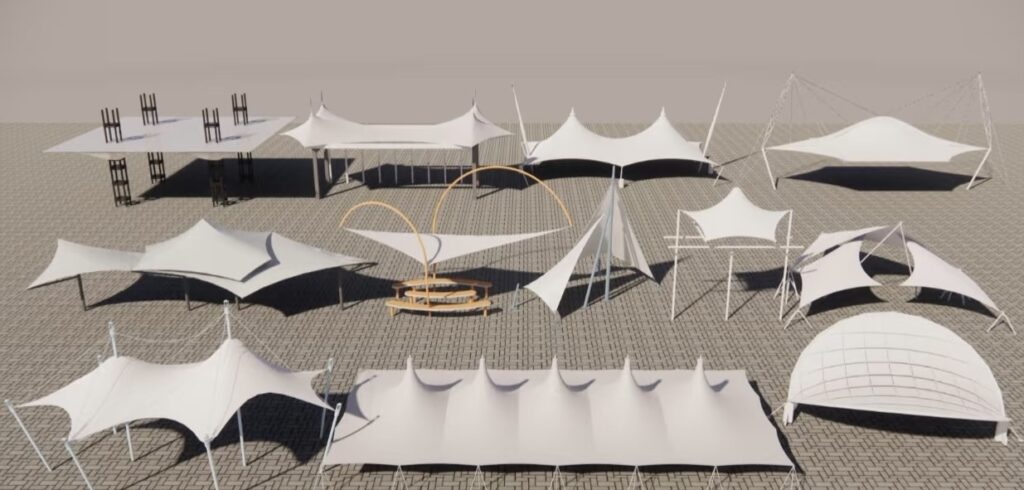

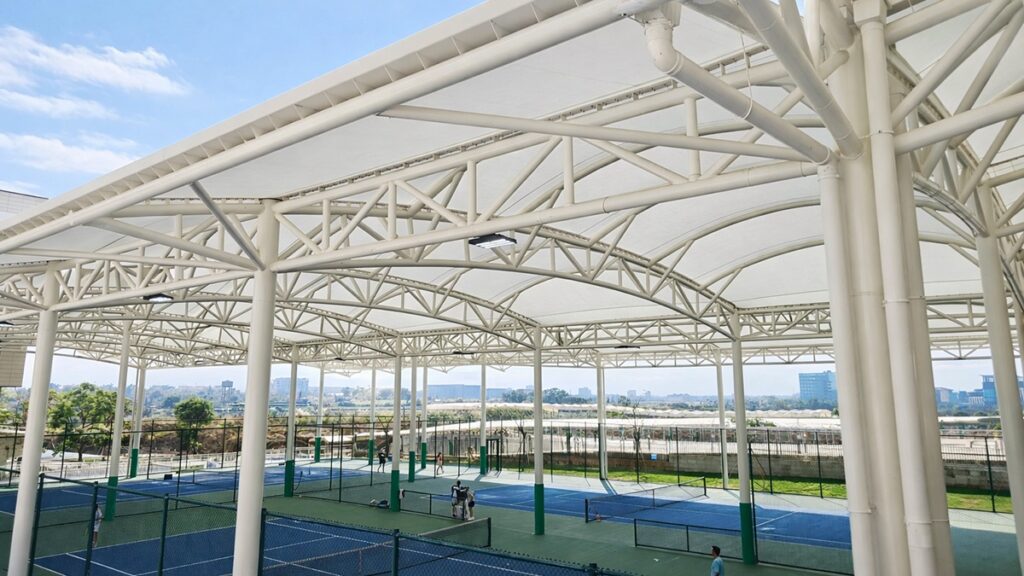
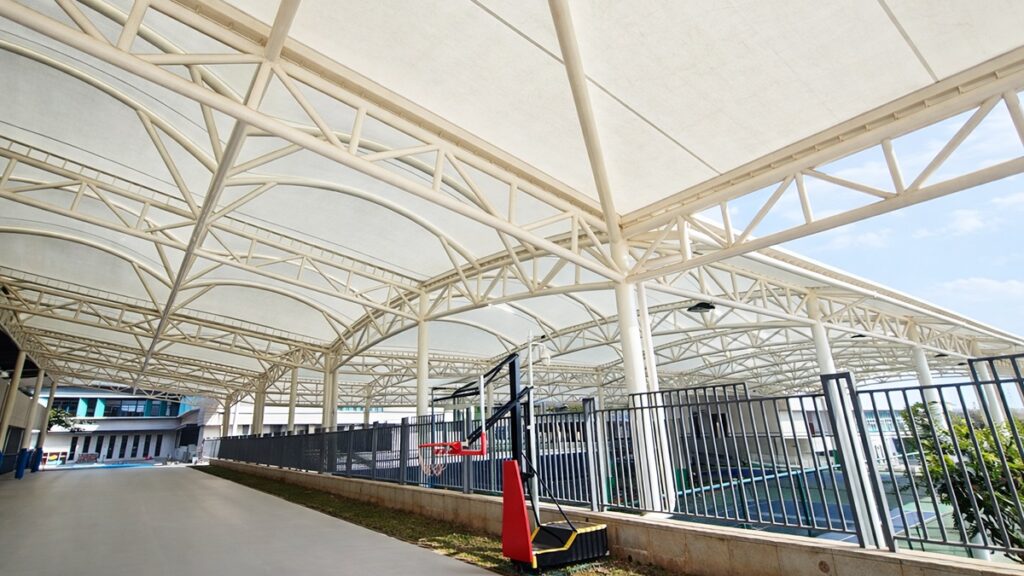
The fabrication of membrane structures is a systematic engineering process encompassing design → cutting → welding → and installation/tensioning. Its core objective is to:
👉 Ensure uniform stress distribution across the membrane surface + precise geometric form + reliable structural strength.
Membrane Structure Fabrication Workflow
1️⃣ Conceptual Design and Form-Finding Analysis
This constitutes the most critical step in the membrane structure process. Utilizing specialized software (e.g., Easy, Formfinder)
Conducting Form-Finding analysis
Determining membrane surface curvature and stress states
Calculating wind and snow loads
👉 Result: A stable 3D curved surface model is obtained.
2️⃣ Membrane Patterning Design
Converting the 3D curved surface into 2D cutting patterns:
Panel layout design
Stress compensation (Pre-stress compensation)
Determining splicing directions
👉 Key Point:
Cutting errors directly impact the quality of the final installation.
3️⃣ Membrane Cutting
Using automated CNC cutting machines
Precision controlled within ±1mm
Common materials:
PVDF membranes
PTFE membranes
ETFE membranes
👉 Requirements:
Smooth edges and precise dimensions.
4️⃣ Membrane Welding
One of the core manufacturing processes 🔥
Common welding methods:
High-Frequency (HF) Welding
Hot Air Welding
Hot Wedge Welding
👉 Requirements:
Weld seam strength ≥ Membrane material strength
Waterproof and tear-resistant properties.
5️⃣ Edge Reinforcement
Reinforcement belts
Edge folding/binding
Cable connection points
👉 Enhances tear resistance and structural stability.
Accessories Assembly
Includes:
Cable clamps
Tension cables
Cable end fittings
Steel connection plates
👉 Ensures a reliable connection between the membrane structure and the steel structure.
7️⃣ Pre-assembly & Quality Control (QC)
Trial assembly within the factory
Checking for dimensional errors
Testing weld seam strength
Waterproofing tests
8️⃣ On-site Installation & Tensioning
Unfolding the membrane body
Connecting to the steel structure
Phased tensioning
Adjusting for uniform tension
👉 Key Factor:
Uniform tension = Structural stability + Aesthetic appeal.
II. Key Technical Highlights of Membrane Structure Fabrication
🔹 1. Pre-stress Control
Ensures the membrane surface prevents water accumulation and avoids deformation.
🔹 2. Weld Strength
Determines overall structural safety.
🔹 3. Cutting Precision
Directly impacts installation difficulty
🔹 4. Joint Design
Crucial for the connection between steel structures and membranes
Advantages of Membrane Structure Fabrication:
Factory prefabrication ensures stable quality
Short construction cycles
Capable of achieving complex shapes
Suitable for large-span structures
High installation efficiency
The fabrication process of tensile membrane structures includes form-finding, patterning, cutting, welding and installation. With advanced manufacturing technology and strict quality control, membrane structures ensure high strength, durability and precise architectural performance.